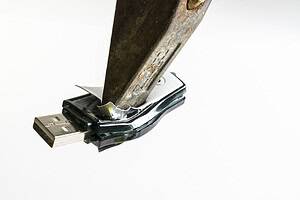
Degaussing is suitable for compatible magnetic storage media, including many conventional hard disk drives and magnetic backup tapes. It is not suitable for solid-state drives, USB flash drives, memory cards or other storage technologies that retain information electronically rather than magnetically.
That distinction is the most important starting point.
A degausser works by exposing storage media to a powerful magnetic field that disrupts the magnetic domains used to represent recorded information. If the device does not rely on magnetic storage, there is nothing for the degaussing field to erase in the same way.
Current NIST guidance states explicitly that degaussing should not be used for non-magnetic storage such as flash-based SSDs. It also notes that effective degaussing depends on matching the equipment to the characteristics of the magnetic media being processed.
Organisations should therefore identify how the media stores data before deciding whether degaussing is an appropriate destruction method.
Why does degaussing only work on magnetic media?
Magnetic storage works by representing information through controlled magnetic states.
A degausser generates a sufficiently strong magnetic field to disrupt those organised states so that the original recorded information can no longer be reconstructed in the normal way.
This principle makes degaussing suitable for technologies such as conventional magnetic hard disk drives and magnetic tape.
Flash memory works differently.
SSDs, USB sticks and memory cards store information electronically within semiconductor memory cells. A magnetic field is therefore not an appropriate way of sanitising the underlying storage medium.
The National Cyber Security Centre similarly describes degaussing as a method for exclusively magnetic media and warns that the equipment must also be sufficiently capable for the specific magnetic device involved.
The correct decision therefore starts with storage technology, not simply with the shape of the device.
Can conventional hard disk drives be degaussed?
Yes, many conventional magnetic hard disk drives can be securely degaussed when suitable equipment is used.
Traditional HDDs store information on magnetic platters inside the drive enclosure.
This includes many:
- laptop hard drives;
- desktop hard drives;
- server hard drives;
- network storage drives;
- enterprise magnetic hard drives.
Varese Secure’s current degausser range reflects these applications. For example, its HD-2XTE is specified for compatible laptop, desktop and network hard drives, while other systems in the range accommodate different drive dimensions and magnetic-media requirements.
However, describing a device as an HDD does not mean every degausser is automatically suitable for it.
Compatibility can also depend on factors such as the drive’s magnetic properties, physical dimensions and the capability of the particular degaussing system.
The media should therefore be checked against the equipment specification before processing.
Can damaged or non-working hard drives still be degaussed?
Yes, provided they are still compatible magnetic hard drives.
One advantage of degaussing is that it does not depend on the operating system, drive interface or normal mechanical operation of the device.
A hard drive does not have to:
- boot successfully;
- appear in an operating system;
- communicate through its interface;
- spin normally;
- contain an intact file system.
The degaussing process acts directly on the magnetic storage medium rather than relying on software access.
Varese Secure states that its compatible degaussing systems can process both working and non-working magnetic hard drives.
This can make degaussing particularly useful where a drive has failed and ordinary software sanitisation cannot be completed.
The important qualification remains that the drive must actually use magnetic storage.
A failed SSD does not become suitable for degaussing simply because it is no longer operational.
Which magnetic backup tapes can be degaussed?
Many common magnetic tape formats can also be degaussed.
Tape storage has historically been widely used for backup, archive and disaster-recovery purposes, meaning organisations can accumulate substantial quantities of end-of-life tapes containing older copies of sensitive information.
Compatible formats within Varese Secure’s current degausser specifications include examples such as:
- LTO;
- DLT;
- AIT;
- 3590-series media;
- 8 mm magnetic tape;
- other compatible magnetic cartridges.
The precise formats supported vary by degausser and should be checked against the current equipment specification.
This is especially important with less common or legacy tape formats.
Rather than assuming that any object described as “tape” is compatible, organisations should establish whether the cartridge contains magnetic storage media and whether its size and characteristics fall within the degausser’s supported range.
Can LTO tapes be degaussed?
Yes, compatible LTO magnetic tapes can be degaussed.
LTO, or Linear Tape-Open, is a magnetic tape storage format widely used for enterprise backup and archival storage.
Current Varese Secure specifications for several Garner degaussers list LTO media among their supported tape formats.
Degaussing an LTO tape disrupts the magnetic information recorded on the tape and renders the stored information unusable.
As with hard drives, the organisation should use equipment specifically documented as suitable for the media being processed rather than assuming that every degausser provides the same capability.
Can DLT and older magnetic tapes be degaussed?
Many can.
DLT, AIT, 8 mm and various other magnetic tape formats fall within the media specifications of suitable professional degaussers.
This can be particularly relevant when organisations are clearing historic archives.
Legacy media sometimes receives less attention than current hard drives because it may have been stored untouched for years. However, an old backup tape can still contain complete copies of historic business systems, customer information or operational records.
Its age does not make the information automatically safe.
If the media remains readable and has not been securely sanitised, the data risk remains.
Degaussing can therefore provide a practical route for compatible legacy magnetic tapes where reuse is not required.
Can floppy disks be degaussed?
Magnetic floppy disks are, in principle, susceptible to degaussing because they store information magnetically.
However, whether a particular professional degausser is intended to process them should still be checked against the equipment manufacturer’s specifications.
This illustrates an important distinction.
There are two separate questions:
Is the storage technology magnetic?
and:
Is this particular item approved or suitable for processing in this particular degausser?
The answer to the first question may be yes while the second still requires confirmation.
This is why media compatibility should be established from technical specifications rather than assumptions.
Can solid-state drives be degaussed?
No.
SSDs use flash memory rather than magnetic platters.
NIST explicitly states that degaussing should not be used for flash-based SSD storage.
Using a more powerful degausser does not change that.
This is a storage-technology limitation, not simply a field-strength problem.
An SSD could be placed inside a degausser and emerge looking unchanged or possibly affected in other ways, but the organisation would not have a reliable basis for claiming that its flash memory had been securely sanitised.
SSDs need an appropriate solid-state sanitisation or physical destruction method instead.
Varese Secure separates these technologies within its own equipment range. Its degaussing systems are intended for magnetic hard drives and tapes, while solid-state and flash media require suitable physical destruction equipment.
Can USB memory sticks be degaussed?
No.
USB memory sticks normally use flash memory, so they present the same fundamental problem as SSDs.
The information is stored electronically rather than magnetically.
A degausser should therefore not be selected simply because the USB stick is small enough to fit inside the chamber.
Physical dimensions do not determine compatibility.
The storage technology does.
USB flash media requires an appropriate destruction or sanitisation method designed for solid-state storage.
Can SD cards and microSD cards be degaussed?
No.
SD and microSD memory cards are also flash-based storage devices.
They therefore cannot be securely sanitised through degaussing.
This is particularly important because these devices are physically small and can easily be mixed into batches containing other storage media.
A secure destruction workflow should classify media before processing so that flash memory is not accidentally passed through a process intended only for magnetic storage.
That classification stage becomes increasingly important in organisations managing large or diverse IT estates.
Can mobile phones and tablets be degaussed?
Modern phones and tablets generally use solid-state flash memory.
Degaussing is therefore not an appropriate method for sanitising their internal storage.
The same applies to many other modern embedded devices.
What matters is not whether the device contains electronics or whether it once functioned as part of an IT system. The organisation needs to identify the technology that actually stores the information.
This can be less obvious with integrated devices than with removable hard drives.
For that reason, organisations should not assume that every data-bearing device can simply be placed through one standard destruction process.
What about hybrid drives?
Hybrid devices require particular care.
Some storage devices combine magnetic and solid-state technologies in one unit.
NIST highlights the increasing complication created by hybrid combinations of magnetic and non-magnetic storage and warns that degaussing should not be assumed to sanitise non-magnetic components.
This means an organisation cannot necessarily degauss a hybrid device and conclude that every part of it has been securely sanitised.
If one component stores information magnetically and another stores information in flash memory, each storage technology needs to be accounted for.
A suitable physical destruction process may therefore be required to address the complete device.
Can CDs and DVDs be degaussed?
No.
Optical media such as CDs, DVDs and Blu-ray discs do not rely on magnetic storage in the way that hard disk platters and magnetic tapes do.
A magnetic degausser is therefore not an appropriate sanitisation method.
Optical media normally requires another method of secure physical destruction where sensitive information must be made irrecoverable.
Again, the useful rule is to think in terms of storage technology, not just “computer media”.
Can magnetic media be degaussed through its casing?
Professional degaussers are specifically designed to expose supported media to the required magnetic field without requiring users to dismantle every hard drive or tape cartridge first.
For example, Varese Secure’s equipment specifications describe processing complete compatible hard drives and tape cartridges within the degausser chamber.
The user should nevertheless follow the equipment’s published loading and dimensional requirements.
A device being magnetic does not automatically mean that it can be placed into a machine regardless of size, construction or manufacturer guidance.
Does the physical size of the media matter?
Yes.
Even where the storage technology is compatible, the device still has to fall within the physical capabilities of the equipment.
Professional degaussers have defined chamber or drawer dimensions.
For example, different Varese Secure models accommodate different hard-drive heights, meaning an organisation processing larger enterprise drives may need a different system from one processing standard laptop drives.
This creates three separate compatibility checks:
- Is the storage technology magnetic?
- Can the degausser produce an appropriate field for that media?
- Does the device physically fit within the specified processing chamber?
A positive answer to only one or two of these questions is not enough.
Does magnetic media always remain reusable after degaussing?
No.
Degaussing is generally used where continued use of the media is not required.
On magnetic hard disk drives, the process can also disrupt servo information and other magnetic information needed for normal operation, leaving the drive unusable.
NIST cautions that degaussing can render some media inoperable.
This is an important procurement consideration.
If the organisation intends to sanitise equipment and then resell or reuse the same hard drives, degaussing may not support that objective.
If the requirement is permanent sanitisation before disposal or physical destruction, the loss of usability may be entirely acceptable.
The intended destination of the hardware therefore matters when choosing a sanitisation method.
Should degaussed hard drives also be physically destroyed?
That depends on the organisation’s security requirement.
Degaussing and physical destruction perform different functions.
Degaussing targets the magnetic information stored on compatible media.
Physical destruction prevents the device from being reused and can provide an additional physical security control.
Some organisations may consider properly validated degaussing sufficient for their requirement. Others may adopt a degauss then destroy process for higher-assurance disposal.
Varese Secure’s current approach reflects this distinction by offering degaussing, physical destruction and verification equipment as complementary components of a secure media-disposal process.
The appropriate combination should be based on the sensitivity of the information, organisational policy and any applicable contractual or regulatory requirements.
How should businesses separate mixed media for destruction?
A mixed-media environment benefits from classifying devices before processing.
A typical IT estate might contain:
- conventional HDDs;
- SSDs;
- USB drives;
- backup tapes;
- SD cards;
- optical media.
Sending everything through the same equipment would not provide a reliable sanitisation outcome.
A practical first step is to separate assets into magnetic, solid-state/flash and other storage technologies.
The precise destruction route can then be selected for each category.
The NCSC recommends planning sanitisation as part of equipment management and considering the relevant method based on the technology and security risk involved. It specifically notes that SSDs can be difficult to sanitise reliably and may warrant physical destruction.
This kind of media classification is especially valuable during large-scale data-centre clearances or IT refresh projects, where several generations of storage technology may be present at once.
What should organisations check before degaussing an unfamiliar device?
If there is uncertainty about a device, it should not simply be processed on the assumption that degaussing will work.
Check:
- whether the data-bearing component is magnetic;
- the manufacturer’s media specifications;
- the degausser’s documented compatibility;
- the device’s dimensions;
- the required magnetic-field capability;
- whether the device contains additional non-magnetic storage;
- what evidence is needed after processing.
Varese Secure states that the correct degausser should be selected according to factors including media coercivity, dimensions and processing volume.
If the storage technology cannot be confidently identified, specialist assessment is preferable to assuming successful sanitisation.
Frequently Asked Questions
Can SATA hard drives be degaussed?
If the SATA drive is a conventional magnetic HDD and falls within the degausser’s specifications, it can potentially be degaussed. SATA describes an interface and does not by itself establish whether the underlying storage is magnetic or solid-state.
Can SAS hard drives be degaussed?
Many SAS enterprise hard drives use magnetic storage and may be suitable for degaussing. Compatibility should still be confirmed against the particular degausser’s technical specification and the drive’s dimensions.
Can NVMe drives be degaussed?
NVMe SSDs use solid-state flash storage and should not be treated as magnetic hard drives. Degaussing is not an appropriate sanitisation method for them.
Can backup tapes be reused after degaussing?
Degaussing is normally used as a permanent sanitisation process rather than to prepare magnetic tapes for normal reuse. Organisations should follow the media manufacturer’s guidance and their own disposal requirements.
Can an encrypted hard drive still be degaussed?
Encryption and degaussing address data security differently. If the device is a compatible magnetic hard drive, encryption does not prevent it from being degaussed. The organisation should still ensure the selected destruction process meets its security requirements.
Match the destruction method to the storage technology
The simplest way to understand degaussing compatibility is to start with one rule:
Degaussing is for compatible magnetic storage media.
That commonly includes conventional magnetic hard drives and a range of magnetic backup tapes.
It does not include SSDs, USB flash drives, memory cards, optical discs or other non-magnetic storage technologies.
Even within the magnetic category, organisations should not assume that every degausser works with every device. Field capability, drive dimensions and the specific media specification still matter.
For organisations managing mixed IT estates, the safest approach is therefore to identify the media first and select the destruction process second.
Varese Secure supplies degaussing and physical destruction equipment for organisations handling magnetic hard drives, tapes, solid-state drives and flash storage, helping businesses match the sanitisation method to the media involved.
Phone: 01489 854 131
Email: sales@varese-secure.co.uk
Find out more: https://varese-secure.co.uk/
-
Is Deleting Files or Formatting a Drive Enough Before Disposal?
No. Simply deleting files or performing a standard reformat should not normally be treated as secure data destruction. Those actions may remove files from ordinary view or recreate the drive’s file system, but they do…
-
Can Damaged SSDs Still Contain Recoverable Information?
Yes. A damaged SSD can still contain recoverable information even when the device no longer works normally. The key distinction is between device failure and data sanitisation. An SSD may stop appearing in a computer,…
-
What Should Compliance Teams Check Before Approving a Data Destruction Process?
Approving a data destruction process should involve more than checking whether a supplier promises to “securely destroy” old IT equipment. Compliance teams need to understand what is being destroyed, which destruction method will be used,…