As data protection becomes more critical in business operations, the pressure to dispose of old hard drives safely and legally has never been higher. One of the most frequently asked questions is whether degaussing hard drive destruction offers the highest level of security.
In this blog, we’ll break down how degaussing works, where it fits in the hierarchy of secure disposal methods, and whether it’s the right choice for your organisation.
What Is Degaussing?
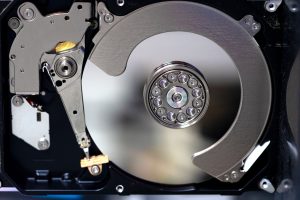
Degaussing is a method of magnetic data erasure that uses a powerful magnetic field to permanently disrupt the magnetic domains on a hard drive or tape. Unlike software-based data wiping, which simply overwrites data, degaussing completely removes the drive’s ability to store or recall data—making recovery impossible.
This method is widely used in sectors that handle sensitive or regulated data, such as:
- Financial institutions
- Healthcare providers
- Legal firms
- Government bodies
- Security-focused enterprises
How Does Degaussing Work?
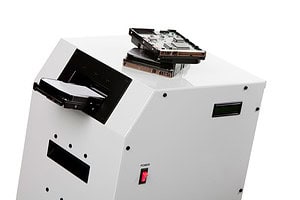
Using a machine called a degausser, a strong electromagnetic field is applied to the storage device. This magnetic pulse scrambles the alignment of particles on the drive’s platters or tape, rendering all data, including firmware and file systems, unreadable.
Key points to note:
- The process takes just seconds per drive.
- It is only effective on magnetic storage (e.g., HDDs and magnetic tapes).
- After degaussing, the drive is permanently unusable.
It’s important to remember that degaussing is not effective on solid-state drives (SSDs), which store data electronically rather than magnetically.
Is Degaussing the Most Secure Method?
For traditional hard drives, degaussing is among the most secure methods of data destruction. It eliminates the possibility of recovery and is often used by high-security industries to meet strict compliance requirements.
Key Advantages of Degaussing:
- Complete erasure: Unlike standard deletion or formatting, degaussing leaves no trace of data.
- Quick process: Each drive can be wiped in seconds, making it suitable for bulk disposal.
- Non-reliance on software: There’s no need for overwriting tools or manual data removal.
- Supports data compliance: Ideal for businesses needing to meet GDPR, ISO 27001, or IT asset disposal requirements.
Limitations of Degaussing:
- It only works on magnetic media (not SSDs).
- It destroys the drive, making it unusable for resale or reuse.
- There’s no visual sign of destruction, so a certificate of degaussing is essential for audit purposes.
Degaussing vs Other Data Destruction Methods
When comparing degaussing to other forms of hard drive sanitisation, it’s essential to consider your organisation’s priorities: compliance, speed, cost, and environmental impact.
Here’s how degaussing compares:
- Degaussing is fast, highly secure, and best for HDDs. It renders drives unusable and requires professional equipment.
- Shredding physically destroys drives, including SSDs, and provides visible proof of destruction. It’s highly secure but slower and often more costly for large quantities.
- Software-based data wiping allows drives to be reused but may leave traces of data. It is less secure unless verified with multiple overwrite passes.
For maximum security, many businesses choose to combine degaussing with physical shredding, ensuring both magnetic erasure and visible destruction.
Why UK Businesses Are Turning to Degaussing
With increasing regulatory scrutiny and GDPR enforcement, UK organisations are turning to professional degaussing providers for peace of mind. Services like those offered by Varese Secure provide:
- Certified degaussing with audit-ready documentation
- On-site options to keep sensitive data within your premises
- Environmentally responsible disposal through WEEE recycling and IT asset disposal
Degaussing supports data breach prevention by ensuring all stored data is irrecoverable, especially in industries where even a minor breach could cause financial or reputational damage.
Degaussing is a highly secure and efficient method for destroying data on traditional hard drives. It eliminates the risk of data recovery, meets UK compliance standards, and is especially valuable in high-security industries. While not suitable for SSDs, when paired with physical shredding or proper disposal, it provides one of the most robust defences against data breaches.
Want trusted degaussing services in the UK?
Visit our secure solutions here: Varese Secure – Degaussing Services
Contact Us:
Phone: +44 (0)1489 854 131
Email: sales@varese-secure.co.uk
Degaussing Hard Drive Destruction FAQs
Q1: Is degaussing hard drive destruction compliant with GDPR and UK data laws?
A1: Yes. Degaussing hard drive destruction meets the legal requirement for secure data destruction under GDPR and supports data protection compliance. It’s considered a highly effective method when performed by certified providers.
Q2: Can degaussing hard drive destruction be used on all types of drives?
A2: No. It only works on magnetic storage devices like traditional HDDs and tapes. SSDs must be physically destroyed, as they use flash memory, which is unaffected by magnetic fields.
Q3: What should I do after degaussing hard drive destruction?
A3: Since the drive is no longer functional, it should be processed through certified IT asset disposal or WEEE recycling channels. A reputable provider will handle this for you and provide full documentation.
-
What Is Chain of Custody in Secure Data Destruction?
Chain of custody in secure data destruction is the documented record of who controlled data-bearing assets, where those assets were held and when responsibility passed from one person, team or organisation to another. Its purpose…
-
How Strong Does a Degausser Need to Be to Destroy Hard Drive Data?
There is no single magnetic-field strength that automatically makes a degausser suitable for every hard drive. The important relationship is between the magnetic field produced by the degausser and the coercivity of the magnetic media…
-
Why Asset Serial Numbers Matter in Data Destruction
When an organisation sends 100 hard drives for secure destruction, knowing that 100 drives were destroyed is useful. Knowing which 100 drives were destroyed provides a much stronger level of traceability. That is where asset…