There is no single magnetic-field strength that automatically makes a degausser suitable for every hard drive.
The important relationship is between the magnetic field produced by the degausser and the coercivity of the magnetic media being processed. The degausser must be sufficiently powerful for the particular media and recording technology involved.
This matters because modern magnetic storage has evolved. Hard drives with higher-density recording can require stronger magnetic fields than older media, meaning a degausser that was suitable for previous generations of drives should not automatically be assumed to be suitable for current equipment.
Current NIST guidance makes this point explicitly. NIST SP 800-88 Revision 2, published in September 2025, states that degaussing can render magnetic information storage media purged when the strength of the degausser is carefully matched to the media’s coercivity. It also warns that some existing degaussers may lack sufficient force for newer magnetic recording technologies.
So the useful question is not simply “How many gauss does a degausser produce?” It is “Is this degausser demonstrably suitable for the media we need to sanitise?”
What determines whether a degausser is powerful enough?
A degausser works by exposing magnetic storage media to a powerful magnetic field.
Hard disk drives store information using controlled magnetic states on their recording surfaces. Effective degaussing disrupts those magnetic patterns to a point where the recorded information can no longer feasibly be recovered.
For that to happen reliably, the magnetic field must be appropriate for the coercivity of the media.
This creates an important distinction between degaussing equipment.
Two machines may both be described as hard drive degaussers, but their field strengths, chamber designs, supported media and verified capabilities may differ considerably.
The specification therefore needs to be assessed as a complete system rather than by looking at one headline figure.
What is hard drive coercivity?
Coercivity describes how resistant a magnetic material is to changes in its magnetisation.
In practical terms, media with higher coercivity requires a stronger magnetic influence to alter its recorded magnetic state.
This is why developments in magnetic storage technology matter to data destruction.
As manufacturers increase storage densities and change recording technologies, the magnetic properties of the media can also change. A degaussing system suitable for one generation of media may not necessarily provide adequate sanitisation for another.
NIST SP 800-88 Revision 2 specifically notes that degaussing has become more complicated as magnetic recording technologies have developed higher coercivity. It warns organisations against assuming that existing equipment will necessarily have sufficient force for newer information storage media.
This is an important consideration for organisations operating degaussers over long periods. A machine should not be regarded as permanently suitable simply because it successfully processed the hard drives being used when it was purchased.
Does a degausser simply need to exceed the drive’s coercivity?
The basic principle is that the degaussing field needs to be appropriately matched to the media’s coercivity, but procurement decisions should not normally be reduced to a simple comparison between two numbers.
There are several reasons for this.
The magnetic properties of a hard drive may not be clearly stated on the product label. Even where technical information is available, organisations also need confidence that the degausser produces the required field consistently throughout its intended operating cycle and chamber.
Current NIST guidance therefore places greater emphasis on using appropriate standards and verified sanitisation methods rather than relying on an improvised calculation.
NIST SP 800-88 Revision 2 also represents an important change from the older 2014 revision. The current publication moves away from prescribing detailed sanitisation tools itself and instead directs organisations towards relevant standards such as IEEE 2883, NSA specifications or an organisationally approved standard where appropriate.
For a compliance or IT team, that means the manufacturer’s stated media compatibility and supporting technical documentation can matter just as much as the headline field-strength figure.
Is 10,000 gauss enough to degauss a hard drive?
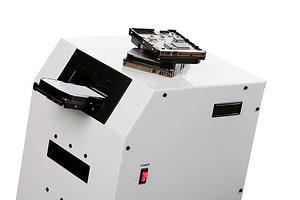
A 10,000-gauss field is a useful example because it is the nominal magnetic field produced by Varese Secure’s HD-2XTE Compact Degausser.
The HD-2XTE specification lists a nominal magnetic field of 1 Tesla, equivalent to 10,000 gauss, and identifies compatible media including laptop, standard and network hard drives up to 1.25 inches in height, alongside a range of magnetic tape formats.
However, the correct conclusion is not that “10,000 gauss is always enough”.
Rather, this illustrates how field strength should be considered alongside the manufacturer’s stated media compatibility.
If an organisation is assessing whether the HD-2XTE is appropriate for its environment, the relevant questions include whether the drives fall within the equipment’s supported media specifications and whether the chosen sanitisation approach satisfies the organisation’s applicable security requirements.
The same principle applies when comparing any degausser.
A field-strength figure is useful technical information. It is not, on its own, proof that every magnetic device placed inside the machine will be securely sanitised.
What do gauss and Tesla actually measure?
Degausser specifications commonly express magnetic-field strength using gauss or Tesla.
They are related units used to express magnetic flux density.
One Tesla is equivalent to 10,000 gauss, so a machine specified at 1 Tesla may also be described as producing 10,000 gauss.
These figures make it easier to compare the stated output of different degaussing systems, but a higher number should not automatically be interpreted as meaning a machine is “more secure” in every circumstance.
What matters is whether the field produced is suitable for the media being processed.
A very powerful degausser used on an incompatible storage technology is still the wrong sanitisation method. Equally, a properly designed degausser with a stated field strength appropriate for its supported magnetic media can provide a controlled sanitisation process without simply pursuing the highest available number.
Can a degausser be too weak even if the hard drive stops working?
Yes. This is one of the most important misconceptions surrounding degaussing.
Making a drive unusable is not necessarily the same as securely sanitising the information stored on it.
A magnetic field can interfere with operational information on a hard drive, including information needed by the drive to function correctly. A drive may therefore fail to operate normally after exposure.
That does not automatically prove that the target data has been adequately sanitised.
NIST warns specifically about this issue. Its current guidance notes that degaussing can make some media inoperable, for example through damage to servo information, while still failing to sanitise the target data if the applied field is unsuitable.
This distinction is critical for secure data destruction.
The objective should not be:
“Does the drive still work?”
It should be:
“Was an appropriate, validated sanitisation process applied to this particular media?”
A failed drive is not, by itself, evidence of successful data destruction.
Why is relying on an old degausser potentially risky?
Degaussers are physical equipment, so it can be tempting to treat them as a long-term fixed capability.
The difficulty is that the storage media being processed does not remain fixed.
A degausser purchased years ago may still power on and perform its intended cycle perfectly. The more important question is whether the drives now entering the organisation’s disposal process remain within its verified sanitisation capability.
This is particularly relevant where an organisation has undergone several hardware refresh cycles.
For example, a business might originally have purchased equipment to process older, lower-capacity magnetic drives. Years later, it could be using substantially different hard-drive technologies while retaining the same destruction equipment.
The machine has not necessarily become defective. Its original specification may simply no longer provide sufficient assurance for the newer media.
Periodic compatibility review is therefore more meaningful than checking only whether the machine appears operational.
What should businesses check before choosing a degausser?
Field strength should be one part of a broader technical assessment.
A compliance, IT or security team assessing equipment should consider the manufacturer’s specified magnetic field, supported media types, physical chamber limitations, relevant standards or certifications, cycle performance and the evidence available to demonstrate that each sanitisation process was completed correctly.
For Varese Secure’s HD-2XTE, for example, the published technical specification identifies both its nominal 1 Tesla field and the categories and physical dimensions of media the unit is designed to accept. It can also be paired with the optional IRONCLAD system, which connects an erasure cycle with an asset record and produces supporting documentation.
That provides considerably more useful information than considering the 10,000-gauss figure in isolation.
Organisations should apply the same approach when comparing other equipment: establish what will actually be processed and then determine whether the equipment is documented and approved for that use.
Does stronger always mean better?
Not necessarily.
If two degaussers are both appropriately specified and validated for a particular hard-drive population, choosing between them may involve other operational factors.
A higher field-strength specification can provide capability for media with higher coercivity, but it does not remove the need to consider throughput, chamber dimensions, workflow, documentation and the media actually being processed.
For a data centre handling large quantities of drives, for example, throughput could be operationally significant.
For a smaller organisation processing comparatively few devices, physical footprint and ease of integrating the equipment into a secure disposal procedure may matter more.
The best specification is therefore not automatically the largest number on a product sheet. It is a system whose capabilities properly match the organisation’s media, security requirements and processing environment.
What about SSDs?
SSDs demonstrate particularly clearly why magnetic-field strength is not the only consideration.
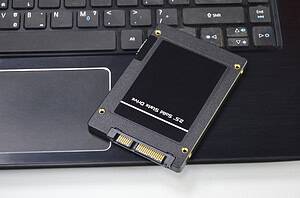
Solid-state drives store information using non-magnetic flash memory. Increasing the strength of a degausser does not turn degaussing into an appropriate sanitisation method for that storage technology.
NIST specifically states that degaussing should not be used for non-magnetic storage such as flash-based SSDs.
This is why an organisation should identify its media before selecting its destruction process.
A mixed IT estate may need different methods for magnetic hard drives and solid-state storage rather than attempting to process every device in the same way.
The wider question of exactly which media can and cannot be securely degaussed deserves separate consideration, but the key point here is simple: degausser strength only matters when degaussing is an appropriate technique for the underlying storage technology.
Frequently Asked Questions
Is 1 Tesla the same as 10,000 gauss?
Yes. One Tesla is equivalent to 10,000 gauss. Degausser manufacturers may therefore express the same nominal magnetic flux density using either unit.
Can you tell a hard drive’s coercivity from its label?
Not necessarily. The technical information needed to assess coercivity may not appear on the drive label, which is one reason organisations should rely on verified media compatibility and appropriate technical standards rather than guessing from basic drive specifications.
Will degaussing physically destroy a hard drive?
Not necessarily. Degaussing targets the magnetic information stored on compatible media. It can also make a hard drive inoperable, but this is different from physically shredding, crushing or otherwise destroying the device.
Can an SSD be degaussed with a stronger machine?
No. An SSD stores its data in non-magnetic flash memory. A stronger magnetic field does not make degaussing suitable for flash storage. An appropriate SSD sanitisation or physical destruction method should be used instead.
Should an organisation replace an older degausser?
Not simply because of its age. The important consideration is whether the equipment remains properly maintained and demonstrably suitable for the media currently being processed. If newer drives fall outside its documented capability, the sanitisation process should be reviewed.
Choosing strength based on the media, not a single number
There is no universal answer such as “every hard drive degausser must produce X gauss”.
Effective degaussing depends on matching the equipment to the coercivity and characteristics of the magnetic media. As storage technologies have developed, that matching process has become increasingly important.
A specification such as 1 Tesla or 10,000 gauss tells you something useful about a machine. What it does not tell you, by itself, is whether that machine is appropriate for every drive your organisation needs to sanitise.
The safer approach is to identify the exact media involved, check the degausser’s documented compatibility and technical specification, and ensure the chosen process meets the organisation’s applicable sanitisation and assurance requirements.
Varese Secure supplies specialist degaussing solutions and provides secure data destruction services for organisations handling sensitive information. The available equipment includes the HD-2XTE Compact Degausser, specified with a nominal 1 Tesla field for compatible magnetic hard drives and tape media.
Phone: 01489 854 131
Email: sales@varese-secure.co.uk
Find out more: https://varese-secure.co.uk/
-
Why Asset Serial Numbers Matter in Data Destruction
When an organisation sends 100 hard drives for secure destruction, knowing that 100 drives were destroyed is useful. Knowing which 100 drives were destroyed provides a much stronger level of traceability. That is where asset…
-
Can Hard Drives Be Destroyed at Your Premises?
Yes, hard drive destruction can be carried out at your organisation’s premises using specialist mobile equipment and a controlled on-site process. On-site hard drive destruction allows data-bearing assets to remain within the organisation’s location until…
-
What Types of Devices Can a Solid-State Media Shredder Destroy?
A solid-state media shredder can destroy a wide range of devices that store data electronically in flash memory. These may include solid-state drives, USB flash drives, memory cards, small storage modules and some data-bearing circuit…