A degausser must generate a magnetic field strong enough to overcome the magnetic properties of the hard drive being processed. There is no single field-strength figure that is suitable for every hard drive because magnetic storage media vary in their construction, recording density and resistance to magnetic change.
For secure data destruction, the degausser should be independently assessed as suitable for the specific type of media being destroyed. Its magnetic field strength must comfortably exceed the coercivity of that media, rather than merely matching it.
This distinction is important. A magnetic field that is too weak may disrupt some information without reliably making all data irrecoverable. For organisations handling personal, financial, medical, legal or government information, partial disruption is not an acceptable outcome.
Choosing the correct degausser therefore requires more than comparing headline gauss ratings. Businesses must consider the media type, the equipment specification, the destruction process and the evidence produced after completion.
How does degaussing destroy data on a hard drive?
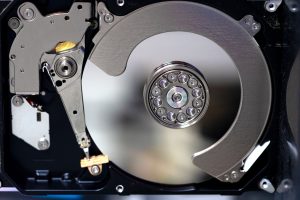
A conventional hard disk drive stores data magnetically. Inside the drive are one or more platters coated with magnetic material. Data is represented through patterns of magnetic orientation across the platter surfaces.
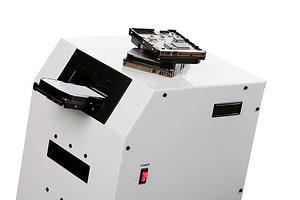
A degausser exposes the drive to an intense magnetic field. This field disrupts and randomises the magnetic patterns used to store the information. When the process is successful, the original data can no longer be read or reconstructed through normal access or specialist recovery methods.
Degaussing does not work in the same way as deleting files or formatting a drive. Those processes generally remove references to the data or make storage space available for reuse. The underlying information may remain present until it has been overwritten.
A correctly specified degausser acts directly on the magnetic recording layer. It affects the physical mechanism through which the information is stored.
The process will also normally damage or erase the drive’s servo information. This is the control data the drive requires to position its read and write heads accurately. As a result, a successfully degaussed hard drive will usually no longer function and should not be expected to return to service.
What determines the magnetic strength needed for degaussing?
The required strength is primarily influenced by the coercivity of the magnetic media.
Coercivity describes how resistant a magnetic material is to changes in magnetisation. Media with higher coercivity require a stronger external magnetic field before their stored magnetic patterns can be reliably altered.
Modern hard drives can use high-density magnetic recording technologies designed to retain information in a very small physical area. As storage density and media design have developed, effective degaussing equipment has also needed to provide sufficiently powerful and controlled magnetic fields.
Several factors should therefore be considered.
The type of storage medium
Not all magnetic media have the same characteristics. A degausser may be intended for:
- Conventional hard disk drives
- Magnetic backup tapes
- Computer tapes and cartridges
- Audio or video tape
- Floppy disks and older magnetic media
An item of equipment that is adequate for low-coercivity tape may not necessarily be suitable for a high-capacity modern hard drive.
The supplier or service provider should be able to confirm exactly which media categories the equipment is designed to process.
The coercivity of the media
The degausser’s field must exceed the media’s coercivity by a sufficient margin. Simply producing a field with a similar numerical rating may not provide the level of assurance required for permanent data destruction.
A professional assessment should consider the effective field delivered to the entire item, not only the maximum field claimed at one point within the machine.
Hard drives contain metal casings, internal components and multiple platter surfaces. The magnetic field must penetrate the drive and affect all relevant storage areas consistently.
The field produced throughout the degaussing chamber
A headline strength rating does not tell the whole story.
A degausser may advertise a high peak magnetic field, but organisations should also consider how evenly that field is distributed. The entire hard drive must receive sufficient exposure during the operating cycle.
Important equipment characteristics can include:
- The strength of the magnetic field
- The size and shape of the processing chamber
- Field uniformity across the chamber
- The duration and control of the degaussing cycle
- The maximum media dimensions accepted
- Manufacturer-approved media classifications
- Cycle monitoring and fault detection
This is one reason businesses should avoid selecting equipment based solely on the largest gauss figure in a product description.
The security level of the data
The sensitivity of the information should influence the destruction method and the amount of verification required.
A drive containing routine internal information may still fall within an organisation’s information security and retention policies. A drive containing special-category personal data, financial records, client files or classified information may require more stringent controls.
The underlying physical process may be similar, but higher-risk information generally requires stronger procedural safeguards. These can include controlled handling, authorised operators, asset-level records, witnessed destruction and certification.
Are gauss and oersted the same measurement?
Gauss and oersted are related, but they do not describe exactly the same thing.
Gauss is commonly used to express magnetic flux density. It describes the magnetic field present within a given area.
Oersted is used to describe magnetic field strength. It is also frequently associated with the coercivity of magnetic media, meaning the level of magnetic force needed to change its magnetic state.
The distinction can become technical because magnetic behaviour also depends on the material through which the field passes. In practical degausser selection, the key point is that equipment and media specifications must be compared correctly.
A business should not assume that two figures are directly interchangeable simply because they appear numerically similar.
The equipment supplier or data destruction specialist should be able to explain:
- What measurement is being quoted
- Where and how the field was measured
- Which media coercivity levels are supported
- Whether the equipment has been tested against relevant hard drive types
- What operational checks confirm that a full cycle has been completed
A high numerical rating has limited value unless it can be connected to a defined and validated media-destruction capability.
How much stronger should the degausser be than the media?
There is no responsible universal multiplier that can be applied to every hard drive.
You may encounter simplified statements suggesting that a degausser should produce a field a certain number of times greater than the media coercivity. While a safety margin is essential, the actual suitability of the equipment depends on its complete design and validated performance.
For example, two degaussers with similar peak field ratings may perform differently because of variations in:
- Chamber design
- Field consistency
- Cycle duration
- Media positioning
- Drive casing penetration
- Quality control
- Equipment maintenance
The safest approach is to choose equipment that has been specifically approved or independently evaluated for the intended media type.
The operating procedure should also follow the manufacturer’s instructions. Running an unsuitable drive through a machine several times does not necessarily compensate for inadequate magnetic strength or poor field penetration.
Can an overly powerful degausser damage nearby equipment?
A degausser is designed to produce an extremely strong magnetic field. This creates operational and safety considerations that must be managed carefully.
The equipment should be installed and operated in accordance with the manufacturer’s instructions. Appropriate separation may be required from magnetic storage media, electronic devices and other sensitive equipment.
Access should be controlled, particularly in data centres, server rooms and IT processing areas where active storage devices may be nearby.
Organisations should also consider individuals with implanted medical devices. Site-specific risk assessments and equipment guidance should be followed before installing or operating a degausser.
These considerations do not mean degaussing is unsuitable for business premises. They mean the process should be planned professionally, with the machine positioned in a controlled environment and operated by trained personnel.
How can an organisation verify that a degausser is suitable?
Verification should begin before any media enters the machine.
A business should identify the storage devices it needs to destroy and confirm that the proposed degausser is suitable for those devices. This should include drive type, physical size, recording technology and any relevant security requirements.
Questions to ask an equipment supplier or destruction provider include:
- Which hard drive types has the degausser been tested to process?
- What is the maximum supported media coercivity?
- How is the magnetic field strength monitored?
- Does the machine identify an incomplete or failed cycle?
- Is each completed cycle recorded?
- What maintenance and calibration checks are required?
- Can the process be incorporated into an asset-level audit trail?
- What documentation is supplied after destruction?
A competent provider should be able to answer these questions clearly. Vague assurances that a machine is “powerful enough” should not replace documented specifications and controlled processes.
Cycle verification
Modern degaussing equipment may include systems that monitor whether the required magnetic field has been achieved during each cycle.
This is useful because it helps distinguish between a cycle that has merely been started and one that has been completed successfully.
However, cycle confirmation should form part of a wider evidence trail. It does not, by itself, identify the device that was processed or prove that the correct asset entered the machine.
Asset-level records
For accountable data destruction, the organisation should maintain a clear connection between the original asset and the completed destruction process.
Depending on the service and the organisation’s requirements, records may include:
- Asset numbers
- Serial numbers
- Device descriptions
- Collection or transfer records
- Date and location of destruction
- Destruction method
- Operator or witness details
- Cycle confirmation
- Certificate of destruction
These records support internal governance and help demonstrate that the organisation followed its documented disposal procedure.
Is degaussing alone enough for secure data destruction?
For magnetic hard drives, correctly performed degaussing can make the stored information permanently inaccessible. Whether it should be followed by physical destruction depends on the organisation’s policy, security requirements and intended disposal route.
Some organisations use a combined process:
- The hard drive is identified and recorded.
- It is processed through a suitable degausser.
- The non-functioning drive is physically shredded or crushed.
- The resulting materials enter an approved recycling route.
- Destruction records are supplied to the client.
The degaussing stage addresses the magnetic information. The physical destruction stage makes the storage device visibly unusable and reduces the drive to material fractions that can be handled for recycling.
This combined approach can provide additional reassurance, particularly when highly sensitive or regulated information is involved.
It is important to note that physical damage alone does not always guarantee that every storage area has been destroyed. Drilling one hole through a drive or striking its casing may leave sections of the platter intact.
Equally, degaussing should not be treated as a generic solution for every storage technology.
Does degaussing work on SSDs?
Degaussing does not reliably erase solid-state drives.
SSDs store information electronically in flash memory chips rather than magnetically on rotating platters. A magnetic field that destroys data on a hard disk drive does not target the storage mechanism used by an SSD.
The same limitation applies to many other flash-based devices, including:
- USB memory sticks
- SD and microSD cards
- Mobile device storage
- Embedded flash memory
- Some storage modules and circuit boards
These devices require a destruction method designed for solid-state media. This may involve specialist crushing or shredding that reduces the memory-bearing components to a sufficiently small particle size.
An organisation should therefore separate magnetic and solid-state media before destruction. Sending mixed devices through a process without confirming compatibility can leave data-bearing components insufficiently treated.
What can happen when a degausser is not strong enough?
An inadequately specified degausser may create a false sense of security.
The drive may stop working normally, leading an operator to assume that its data has been destroyed. However, device failure and verified data destruction are not the same thing.
A drive can become unreadable because its controller, firmware or servo information has been affected while some magnetic information remains on parts of the platters.
The practical consequences can include:
- Sensitive data remaining recoverable
- Failure to follow the organisation’s disposal policy
- Weaknesses in the audit trail
- Difficulty demonstrating responsible handling
- Increased risk if the asset leaves controlled custody
- Potential exposure of personal or confidential information
This is why the process must be based on validated capability rather than whether the drive powers on after treatment.
Choosing the right approach for your organisation
The correct degausser is one that can reliably process the organisation’s specific magnetic media and provide evidence that the required cycle has been completed.
Businesses should begin by auditing the types of storage media they hold. This avoids applying one destruction method indiscriminately to hard drives, SSDs, tapes and removable flash storage.
They should then determine:
- The sensitivity of the data
- The relevant retention and disposal policy
- Whether destruction will take place on-site or off-site
- Whether degaussing alone is sufficient
- Whether physical destruction should follow
- What asset tracking is required
- What documentation must be retained
For organisations without the equipment, trained operators or processing volume to justify an in-house system, a specialist data destruction provider can manage the process under controlled conditions.
The objective is not simply to expose a drive to a strong magnet. It is to use the correct technology within a documented, traceable and repeatable destruction process.
Frequently Asked Questions
Can an ordinary magnet erase a hard drive?
An ordinary household or workshop magnet should not be relied upon to erase a hard drive. Professional degaussers generate much stronger and more controlled magnetic fields designed to penetrate the drive casing and affect the complete magnetic storage surface.
Can a hard drive be reused after degaussing?
Usually not. Degaussing normally removes or damages the servo information required for the drive to operate. The drive should be treated as destroyed and directed into an appropriate physical destruction or recycling process.
Does a degausser need regular testing?
Yes. The equipment should be inspected, maintained and tested in line with the manufacturer’s requirements. Organisations should also verify that cycle monitoring and safety systems are operating correctly.
Can magnetic backup tapes be degaussed?
Many magnetic tapes can be degaussed, but the equipment must be suitable for their coercivity, dimensions and construction. A degausser intended for one media category should not automatically be assumed to work for another.
Is it possible to degauss hard drives on-site?
Yes. Suitable equipment can be operated at a client’s premises when the environment, safety arrangements and asset-handling procedures have been assessed. On-site processing can help organisations retain oversight of their media throughout destruction.
Should hard drives be shredded after degaussing?
This depends on the organisation’s security policy and risk profile. Combining degaussing with shredding can provide both magnetic data destruction and visible physical destruction of the device.
A degausser must be powerful enough to overcome the magnetic properties of the media being destroyed, but field strength alone is not sufficient evidence of effectiveness. Equipment suitability, field consistency, cycle verification, media compatibility and asset tracking all contribute to a defensible destruction process.
Businesses should confirm that their chosen degausser has been assessed for the relevant hard drive types and that completed destruction can be supported by clear records. SSDs and other flash-based devices must be identified separately because they require a different physical destruction method.
For guidance on selecting a secure process for magnetic hard drives, tapes and solid-state media, contact Varese Secure.
Contact Varese Secure Ltd
Phone: 01489 854 131
Email: sales@varese-secure.co.uk
Find out more: https://varese-secure.co.uk/
-
What Is Chain of Custody in Secure Data Destruction?
Chain of custody in secure data destruction is the documented record of who controlled data-bearing assets, where those assets were held and when responsibility passed from one person, team or organisation to another. Its purpose…
-
How Strong Does a Degausser Need to Be to Destroy Hard Drive Data?
There is no single magnetic-field strength that automatically makes a degausser suitable for every hard drive. The important relationship is between the magnetic field produced by the degausser and the coercivity of the magnetic media…
-
Why Asset Serial Numbers Matter in Data Destruction
When an organisation sends 100 hard drives for secure destruction, knowing that 100 drives were destroyed is useful. Knowing which 100 drives were destroyed provides a much stronger level of traceability. That is where asset…